
Aboveground Storage Tanks acoustic emission testing
Which regions show acoustic activity during a suitable liquid-level or loading condition? Review feasibility, expected output and limitations with IAIS.
The inspection question
Which regions show acoustic activity during a suitable liquid-level or loading condition?
Liquid-filled atmospheric and low-pressure metallic storage tanks, including selected shell and roof regions.
This page describes a technically possible application. Final IAIS service availability, procedure, personnel and equipment are confirmed only after the asset-specific enquiry is reviewed.
How this application can work
Potential acoustic sources
AET can record active acoustic sources in stressed areas covered by the sensor arrangement. Activity may be associated with multiple causes, including mechanical contact and fluid movement.
Conditions required for a meaningful test
Confirm contents, fill level and rate, tank geometry, roof configuration, operational restrictions, sensor access and weather. A flat-bottom tank floor is not necessarily examined by shell-mounted sensors.
What the client can receive
Coverage map, level and operating history, source activity and locations if justified, noise assessment and follow-up priorities.
Limits and follow-up
Use tank-floor tools, UT, visual examination or other targeted methods where needed. Do not interpret an absence of shell-sensor activity as proof of floor integrity.
Sensor placement in context
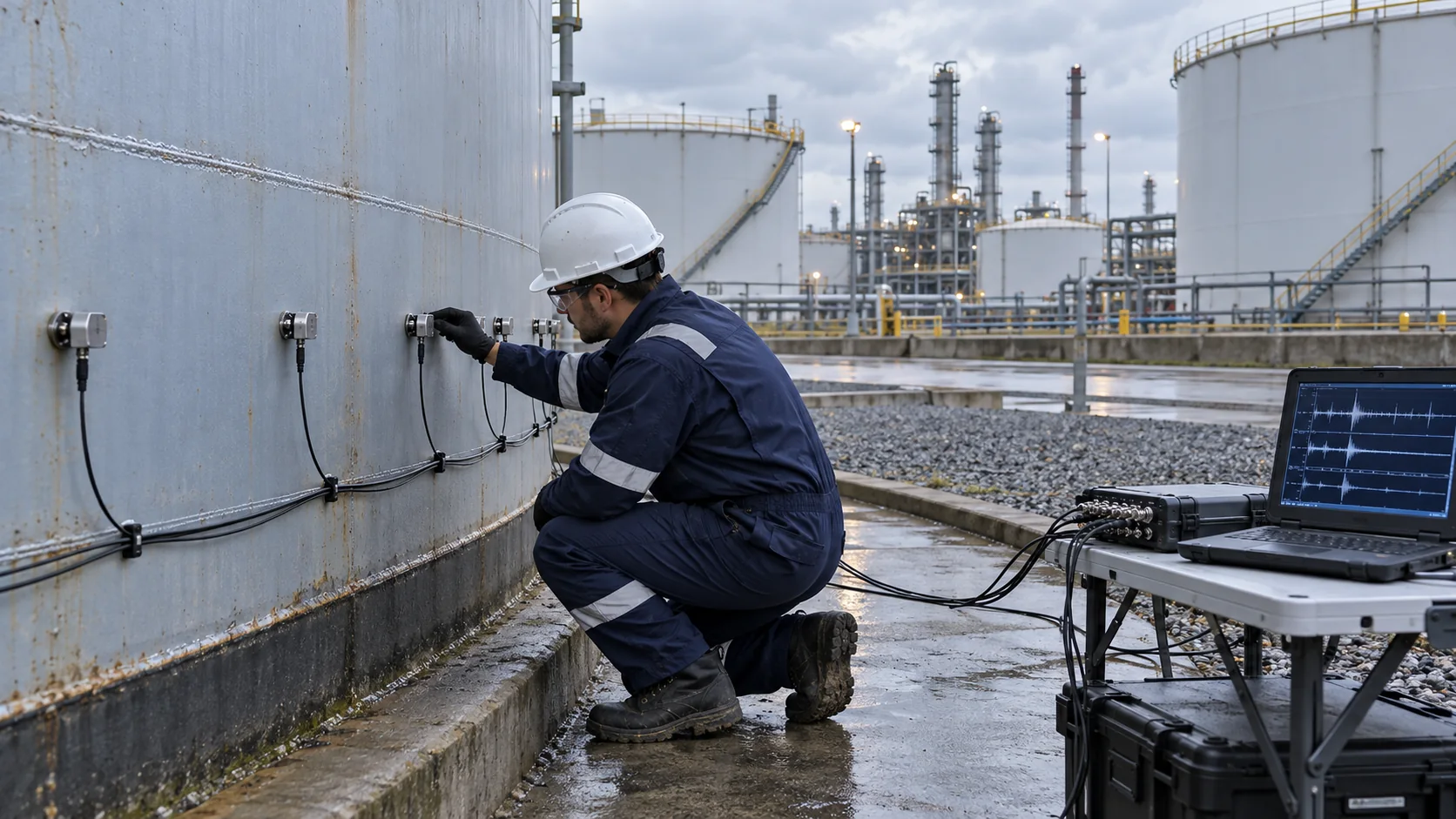
The selected sensor arrangement and the parts of the tank actually covered must be established through the project procedure. Shell placement alone must not be treated as proof of tank-floor coverage.
From enquiry to project scope
Send the asset drawing and material specification, operating and design data, previous inspection records, suspected mechanism, available access, proposed test window and applicable client or regulatory requirements. A feasibility review can then establish sensor coverage, loading or monitoring conditions, background-noise controls, procedure, evaluation criteria and the role of complementary inspection.
Relevant technical reference
ASTM E1930/E1930M. View publisher information. The current edition and its exact scope must be checked before a project procedure is agreed.
Acoustic emission testing in industrial environments
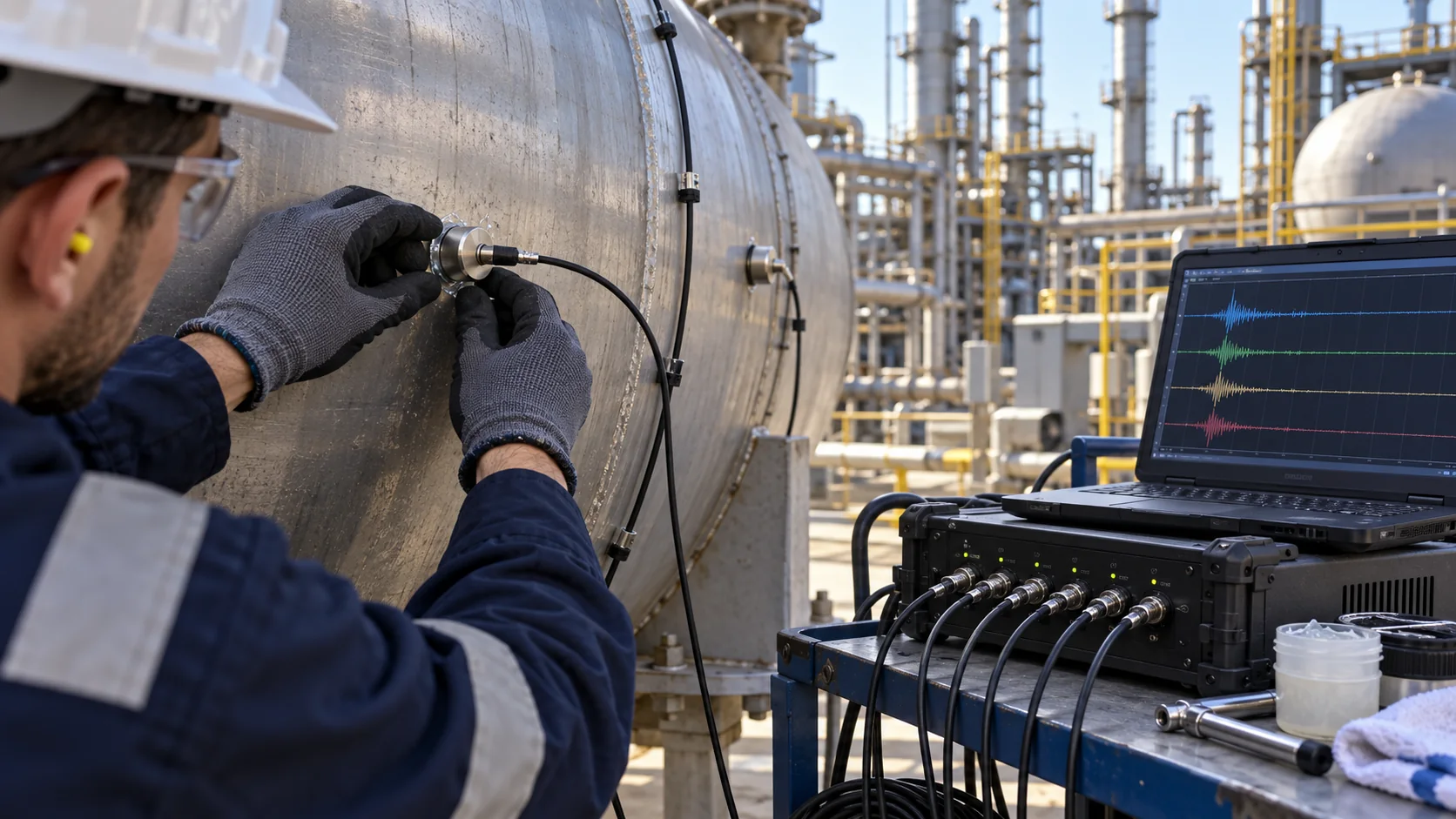
Sensor placement, test conditions and data acquisition are planned around the specific asset and inspection objective.

Discuss your inspection objective
Send the asset type, location, operating conditions and proposed loading or test window. We can review the information before defining a project-specific scope.