
How an acoustic emission assessment is planned
Review AET feasibility, loading, background noise, sensor layout, evaluation and follow-up inspection considerations.
A practical feasibility and execution framework
Inspection objective
Define the exact asset, damage concern, governing requirements and decision to be supported. Separate screening, location, leak confirmation and flaw sizing.
Source activation
Identify a safe pressure, mechanical, thermal or operating stimulus. Determine whether the suspected source is likely to be active within the monitored window.
Sensor coverage
Evaluate geometry, material attenuation, discontinuities in the sound path, coupling, access and suitable sensor positions. Document zones outside validated coverage.
System and noise checks
Verify instrument response, synchronization and coupling; characterize flow, rubbing, impact, rain, EMI and process events.
Data interpretation
Correlate event features with pressure or load, review waveforms, use source-location models only where justified, and apply the agreed procedure.
Decision and follow-up
Report evidence and uncertainty; perform targeted NDT or engineering assessment before attributing a signal to a specific flaw or accepting an asset.
Limitations that affect a real project
Inactive damage can remain silent
AET requires a source that emits during the examination. Absence of reportable activity under one test condition is not proof that no flaw exists.
Coverage is measured, not assumed
Attenuation and complex propagation can reduce the monitored region. Sensor response tests and the procedure define the defensible coverage and localization uncertainty.
Signals require classification
Leaks, moving supports, valve movement, loose items and electrical or weather noise can resemble or conceal relevant events. A signal is not automatically a crack.
Acceptance is application-specific
AE activity cannot be converted into a universal flaw depth, fitness-for-service result or remaining-life figure. Applicable code, engineering assessment and local examination govern those decisions.
Learn how the measurement works → · Review the standards framework →
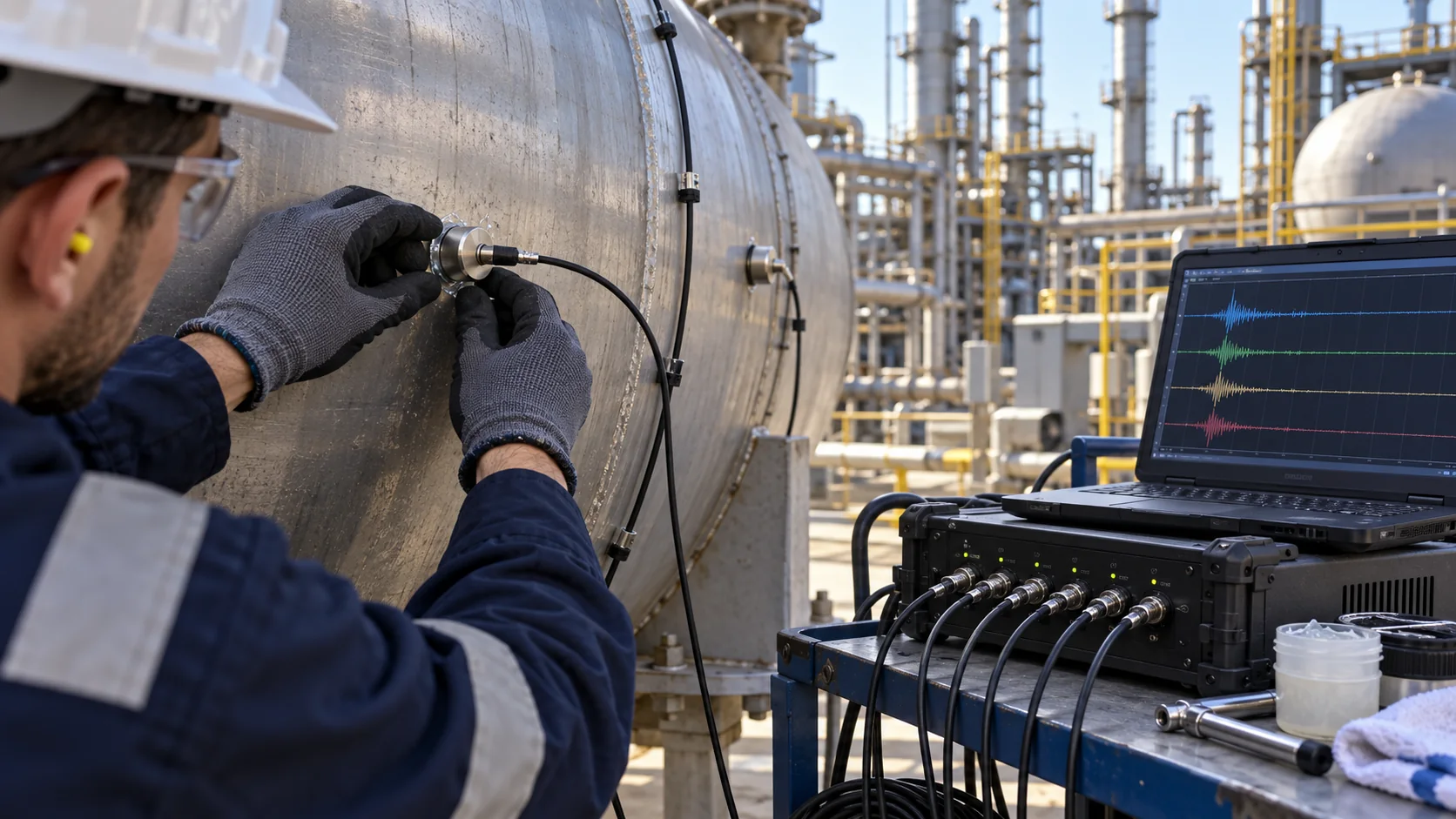
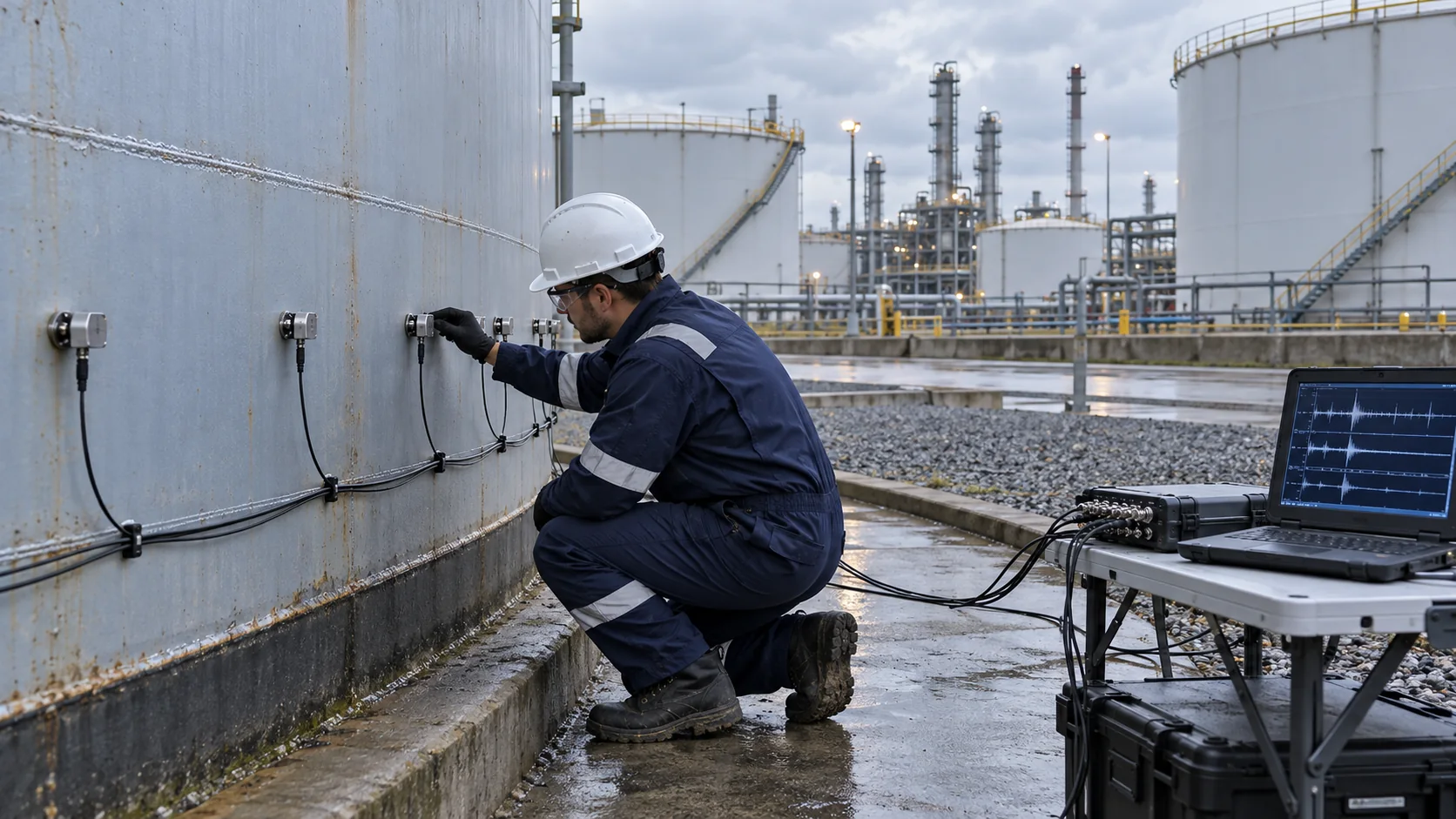
Acoustic emission testing in industrial environments
Sensor placement, test conditions and data acquisition are planned around the specific asset and inspection objective.

Discuss your inspection objective
Send the asset type, location, operating conditions and proposed loading or test window. We can review the information before defining a project-specific scope.